Biologging Tags
Biologging tags are small electronic devices that can be attached to an animal to record and store data about its behavior and physiology as it moves throughout its natural habitat. Biologging tags come in a variety of setups, with different sensors for different purposes. The most common tags used by the MMRP are Customized Animal Tracking Solutions (CATS) tags. These tags contain tri-axial accelerometers, gyroscopes, and magnetometers to sense inertial movement and orientation, pressure sensors to detect depth in the water column, hydrophones to measure acoustics and vocalizations, and video cameras to give visual context for what the animal is experiencing and to help us understand how marine mammals respond to their environment. The combination of these different data streams allow us to answer unique questions related to behavior and health. For example, pairing acoustics with detailed movement data allows us to link vocalizations to specific behaviors to understand how marine mammals communicate and interact with each other. When combined with UAS-photogrammetry, biologging tags can also be used almost like FitBits to measure the energetic cost of different behaviors. Understanding these energy costs allows scientists to evaluate how disturbances may alter whale behavior and whether those changes could affect survival, reproduction, and population recovery.
How it Works:
-
Tags are temporarily attached to whales and dolphins using suction cups deployed from a small research vessel or drone, or attached to hauled-out seals using sheddable adhesive.
-
The tag stays on the animal for a few hours up to a few days, recording high-resolution sensor data including depth, acceleration, orientation, and sound while the animal behaves naturally.
-
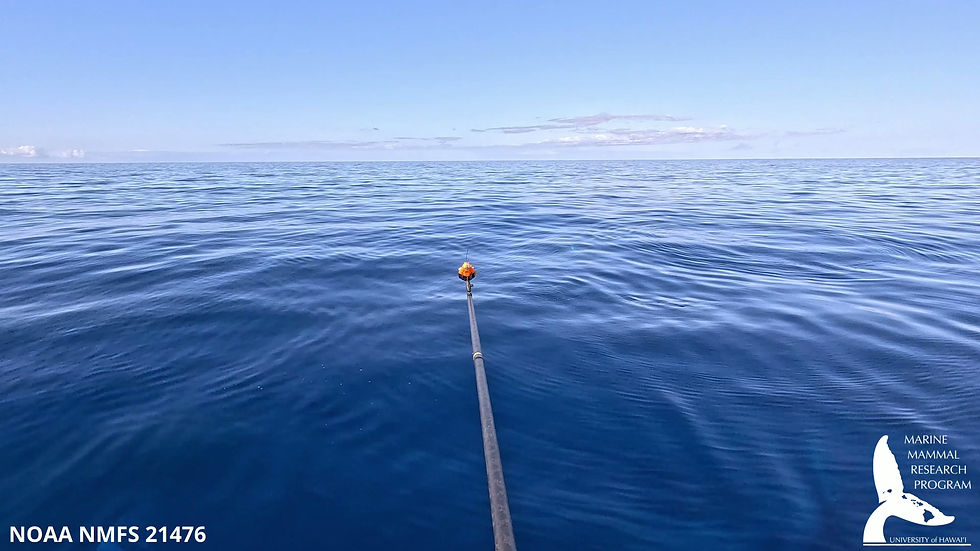
The tag is retrieved: for suction-cup tags the floating tag is recovered using a VHF radio and GPS signal, for seals, the tag is removed from the animal when it hauls out again.
-
Researchers download and analyze the tag data to identify behaviors such as diving, resting, feeding, and socializing, and perform bioenergetic calculations.