
Shippin' out from Scotland

Written by MMRP PostDoc Alec Burslem
For a while it looked like I was going to be a chef.
It was 2009, and after a couple of disappointing A-level results in biology and chemistry had shaken my confidence in studying biology as I had always wanted to, I'd decided to study law. My thinking was that if I wasn’t cut out for science and would be of more use if I became a human rights lawyer and spent my life trying to help people. To make ends meet, I’d worked in a string of restaurant kitchens in London and Oxford, learning a lot about food, life and the world from working, living and drinking with chefs and restaurateurs and as a 19 year old with a fondness for chaos, was enjoying it a fair bit more than my degree. The only surviving picture of me in a kitchen from this time is, I'm afraid to say, from when I lost a St Patrick’s bet against the owner of an Irish pub I was working at.

Eventually, realising I didn’t want to spend my life working the hours everyone else spends playing, I finished my law degree. I spent the next few years working on various civil rights projects and campaigns focusing on the legal rights of adult and child refugees. It was extremely rewarding but, to be honest, was also more than I felt able to handle in the long run and I began to feel it had been a mistake not to pursue science. Eventually, knowing something had to change, I taught myself to code and set myself up as a freelancer providing technical support to some of the charities and campaigns I had worked for. This freed up some time in the evenings to take online courses on biology and ecology which eventually paved the way for me to be admitted to the Marine Environmental management course at the University of York. After a few months there, I knew I had made the right decision and I'll always be incredibly grateful to the faculty there who gave me a second crack at studying biology, a subject that has brought me so much fulfillment and satisfaction ever since. The programme structure includes two mini-dissertations, one hosted at York and another away on placement. At York I looked at the biotech potential of an antarctic extremophilic diatom and I spent my placement in Malta, working on a marine litter project and learning about drone photogrammetry.
While on placement I was offered an internship at Five Oceans Environmental Services: a marine environmental consultancy in Muscat, Oman after their python coder quit and my coursemate mate Matt had put in a good word for me (cheers Matt). So, after a flying visit back to York to present my placement work I was off to the Arabian gulf: where (among a lot else) I got my first exposure to marine mammal work as part of a team droning, tagging and biopsying Arabian sea humpbacks off Masirah island.
When I got back to the UK in early 2018 and it became apparent I was skint, I took a job at a sustainability consultancy working out the carbon footprint of things like the Eurostar and the city of Manchester. While on holiday in the Netherlands, someone emailed me a PhD advert from the University of St Andrews (in Scotland, near Edinburgh) on body condition and behaviour in sperm whales. I lost it. The opportunity to study the physiology of these giants of extreme performance, able to dive to almost three kilometres (1.9 miles) for over an hour and still able to avoid the bends and recover in 7 minutes flat, was incredibly exciting. I applied in early 2019 and, to my surprise, was accepted. I spent the summer as a research assistant aboard HU Sverdrup, a Norwegian naval research vessel, supporting a research cruise which would supply much of my PhD data on body condition and sonar response. Here we conducted experimental sonar exposures on tagged sperm whales, helping us understand how their internal state may influence their response to sonar with the ultimate aim of forecasting the population consequences of anthropogenic noise exposure.

The next year, of course, was 2020. Not ideal. With fieldwork cancelled for the foreseeable future and extremely tight COVID restrictions rolled out across Scotland, I needed a way to make progress on my research questions without leaving my house. We decided to turn to agent based modelling, something which, slightly to my surprise, I found I loved. In my crash-course scientific career up to this point I hadn't given much thought to theory, but I quickly realised that had been a mistake. I was amazed at how effectively translating conceptual ideas into formal mathematical models can help to guide empirical work by revealing the predictions, sensitivities and implicit assumptions of a hypothetical system. This ended up being my first published paper, and a useful reminder that fun and fulfilling science can sometimes come out of unexpected situations.
In 2021 fieldwork was allowed to go ahead and I couldn’t have asked for a better contrast to UK lockdown than Faial, a small island in the Azores archipelago. The week I touched down was the biannual floating music and performance festival which pretty much set the tone for the whole time I was there, it’s a very special place. I met a lot of wonderful people including, for example, Lorenz and Silvio who introduced me to the joys of spearfishing.
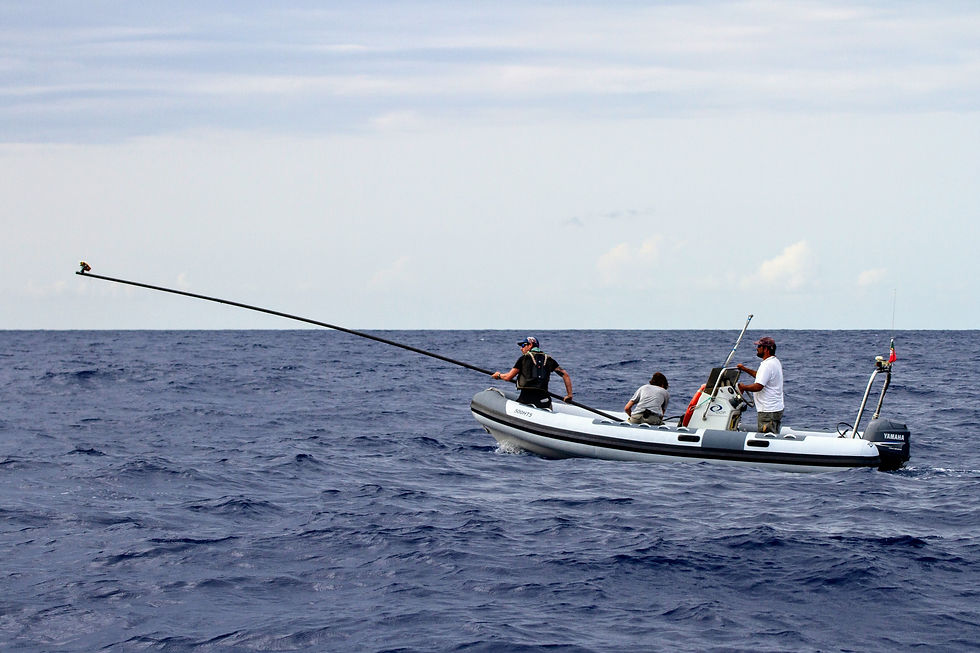
The work I did in the Azores was a switch from theory back to empirical field biology: working on developing improved methodologies for quantifying body condition in whales which are too big to be captured and measured conventionally. It was also my first experience being responsible for my own project out in the field,and here too, I'm indebted to collaborators who went out of their way to help me learn and succeed, particularly Drs Monica Silva and Rui Prieto. We used a combination of drone photogrammetry and tag-based hydrodynamic densitometry to work out the lipid energy content of the whales’ bodies completely non-invasively, simplifying the study of the whales energetics while minimising disturbance.



All this summer fieldwork, combined with the lockdowns meant that I really only had winters to explore Scotland so, having been into rock climbing since I was a teenager, I decided to give the Scottish winter version a go. The ultimate in type 2 fun, Scottish winter climbing typically involves a long early walk in with heavy packs, then 6-8 hours of hoofing it up a mountain with ice tools in a gale wondering if you would be done before it gets dark at 3pm. In time, and with my trusty climbing (and life) partner, Kali, this exercise in masochism grew to include some fun alpine missions to the mountains of France and North Africa.

So, despite a bumpy start, the years I spent doing my PhD turned out to be the best of my life. In a large part, I put this down to my supervisors. I was extremely fortunate to have them and will always be grateful to them for their patience in keeping me on track and the enormous generosity they showed me with their time and expertise to make me a better scientist. We’ve gotten ourselves in a few scrapes over the years, from big scary storms in the Norwegian Arctic to tag retrieval epics through the Mozambican bush. Patrick and Saana have remained unflappable throughout.
My first postdoc continued the same theme of looking at behavioural response to anthropogenic disturbance, this time focusing on the medium-term sonar response dynamics and fisheries interactions of killer whales in the Norwegian sub-arctic. So, 3 days after my PhD defence, I was back on Sverdrup with the 3S4 science crew, working night and day to get tags on killer whales around fishing vessels. I was having a great time working with Patrick and 3S4, but Patrick also encouraged me to move around and experience different ways of working during my postdoc years. So, having spent 5 years at SMRU, it was time for a change.

Which brings me to the here and now: studying the behaviour and physiology of North Pacific humpback whales at the Marine Mammal Research Program at the Hawai’i institute of marine biology. My current project aims to combine methods and themes of my work so far (body condition, energetics, behavioural response, biologging tags) and apply them to a new goal: working out how these animals are affected by multiple stressors at the population level in the medium- to long-term. It’s a hard problem, but I'm confident that we’re well placed to tackle it by building on some truly unique morphometry and photo ID datasets collected by my new colleagues here at MMRP and their collaborators. I guess I won’t be doing much ice climbing here in Hawai’i, but surfing and trail running have done a good job scratching the itch so far and I'll probably live longer this way.
So, that’s how I ended up here HIMB. It’s been an unusual path, involving a few different ‘careers’, but I'm pretty sure this is the last one. I still love to cook, and recently came out of retirement to cater my mates Chloe and Grant’s wedding, but I prefer to keep it as a hobby while I spend my days trying to keep these amazing animals around so they can continue to fascinate and surprise us.


With escalating tension and mysteries concealed within every sip of coffee, Anomalous Coffee Machine demands patience, meticulous observation, and decisiveness to navigate its terrifying twists and uncover the truth behind the enigmatic coffee machine.
Choosing a name for a recipe really does shape how people remember it, just like emphasis shapes a sentence. I tried a bold generator recently to highlight only one key word in a caption, and it made the whole line stand out without overdoing it. Handy for titles and bios too.
Adding more water helps, but the mix gets weaker fast, so I like testing small batches before committing. On the design side, I sometimes turn a photo into a fun graphic with an StickerFaster tool for labels or safety signs. Have you tried a plasticiser instead of extra water for tough pours?
As someone who manages gluten sensitivities while traveling, I appreciate restaurant lists like this. It reminds me of how creative dining has become. On a lighter note, fans of quirky word games might enjoy the jeff goldblum wordle as a fun daily brain break between meals. Thanks for the useful recommendations!
Great point about first impressions during showings. A quick screen check on any smart home devices or TVs you leave behind can prevent a buyer from noticing flaws. I always run a full black screen test on electronics before listing, since even minor dead pixels can distract from the otherwise polished staging.